
HRLUX Lighting | Light the Globe, Power the Future


HRLUX Lighting | Light the Globe, Power the Future
A high mast light in a coastal area must be designed around real wind speed, site exposure, pole height, foundation strength, and structural safety—not simply a single “typhoon level” label. In practical terms, a safe high mast design starts by translating local typhoon risk into engineering loads, then checking the pole, luminaire frame, raising system, anchor bolts, and foundation as one complete structure. This article explains what affects wind resistance, why coastal environments are demanding, and what buyers, contractors, and project teams should review before installation.
A high mast light can only be said to withstand a certain typhoon level when its full design is matched to the wind speed requirements of the project locati0n. There is no universal answer that applies to every pole, because typhoon resistance depends on height, steel thickness, pole shape, lamp head area, number of fixtures, foundation design, terrain category, and local engineering standards. For coastal projects, the better question is not only “How Many Typhoon Levels Can a High Mast Light Withstand? — Wind Resistance Design and Structural Safety in Coastal Areas,” but whether the entire lighting system has been calculated, manufactured, installed, and inspected for the site’s expected wind load.
In many specifications, typhoon resistance is discussed through design wind speed rather than a casual storm category. This matters because a tall mast experiences much higher bending force than a short street light. Even if the light fixtures look compact, the force acting on the pole can increase sharply as wind speed rises. A responsible supplier should therefore provide clear design data, structural drawings, material information, and foundation recommendations instead of relying on broad claims.
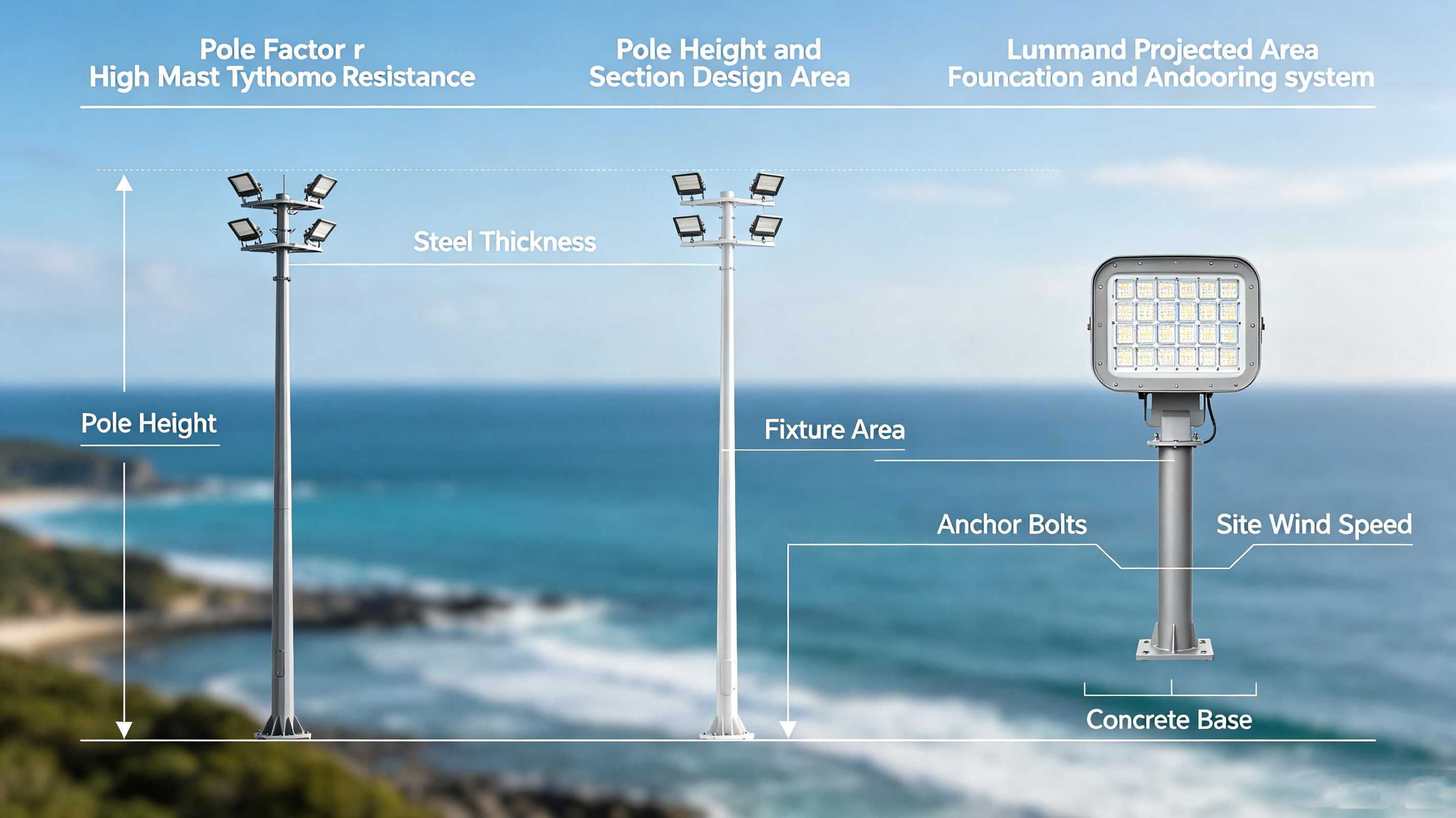
Coastal lighting projects often serve ports, highways, logistics yards, airports, sports areas, container terminals, and large public spaces. These places need tall, reliable illumination, but they are also exposed to open wind, salt air, and heavy rain. A high mast light that works well inland may need stronger structural allowances when installed near the sea.
Good wind resistance design begins with three practical questions:
What is the required design wind speed for the site? The answer should come from local codes, project specifications, and qualified engineering review. Coastal regions may require higher design wind speeds because of typhoon exposure and limited wind barriers.
What is the actual wind area of the complete lighting assembly? The pole, bracket, platform, luminaires, cables, and accessories all contribute to wind loading. Adding more fixtures later can change the structural behavior of the mast.
Can the foundation and anchoring system transfer the load safely? A strong pole is not enough if the anchor bolts, base plate, concrete foundation, or soil conditions are not suitable. Structural safety depends on the whole load path from the lamp head down into the ground.
This is why professional high mast design treats the mast as a complete engineered system. The goal is not just to survive a storm once, but to remain stable, serviceable, and maintainable over many years in a harsh environment.
Several design elements determine whether a high mast light can handle strong typhoon winds. These factors should be reviewed together, because improving one part of the structure while ignoring another can still leave weak points.
Pole height and section design
The taller the mast, the greater the bending moment at the base. A small increase in height can create a meaningful increase in structural demand, especially in open coastal areas. For this reason, pole height should be selected according to lighting requirements, not simply made as tall as possible.
High mast poles are often tapered and segmented to balance strength, weight, manufacturing practicality, and transportation. The diameter, steel thickness, overlap length, welding quality, and section geometry all influence performance. A well-designed pole distributes stress smoothly and avoids unnecessary concentration around openings, welds, and connection points.
Luminaire quantity and projected area
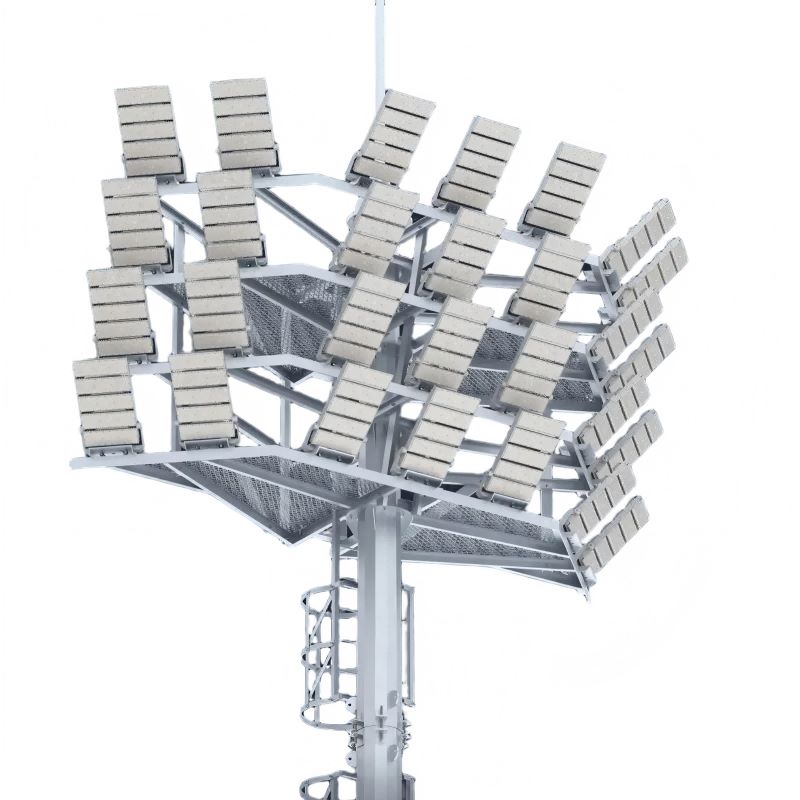
Lighting performance often encourages project teams to add more fixtures, but every luminaire adds wind area and weight. The shape of the lamp frame, the bracket layout, and the orientation of the fixtures can affect wind pressure. Compact, aerodynamic arrangements help reduce unnecessary load, while oversized platforms or poorly arranged brackets can increase stress.
This is especially important when existing masts are upgraded from older fixtures to new LED systems. LED luminaires may be lighter in some cases, but the final assembly still needs to be checked. A retrofit should never assume that “newer” automatically means structurally safer.
Material strength and corrosion protection
Steel grade, fabrication accuracy, welding, galvanizing, and surface treatment all affect long-term reliability. In coastal environments, corrosion is not a minor cosmetic issue. Salt spray can attack exposed metal, fasteners, access doors, internal components, and damaged coating areas.
Hot-dip galvanizing, suitable paint systems, stainless or protected hardware, sealed electrical compartments, and careful drainage details can all contribute to longer service life. The key is consistency. A mast with strong main steel but weak bolts, poor sealing, or unprotected cut edges may still develop problems over time.
Base plate, anchor bolts, and foundation
The foundation is often hidden after installation, but it is one of the most important parts of wind resistance. Anchor bolt diameter, embedment, spacing, nut tightening, base plate thickness, grout quality, concrete grade, and soil bearing conditions must be compatible with the design load.
For coastal areas, foundation design may also need to consider groundwater, soft soils, flood exposure, and corrosion of embedded parts. A proper site survey and engineering calculation are worth the effort because foundation repair after installation is far more difficult than doing it correctly from the start.
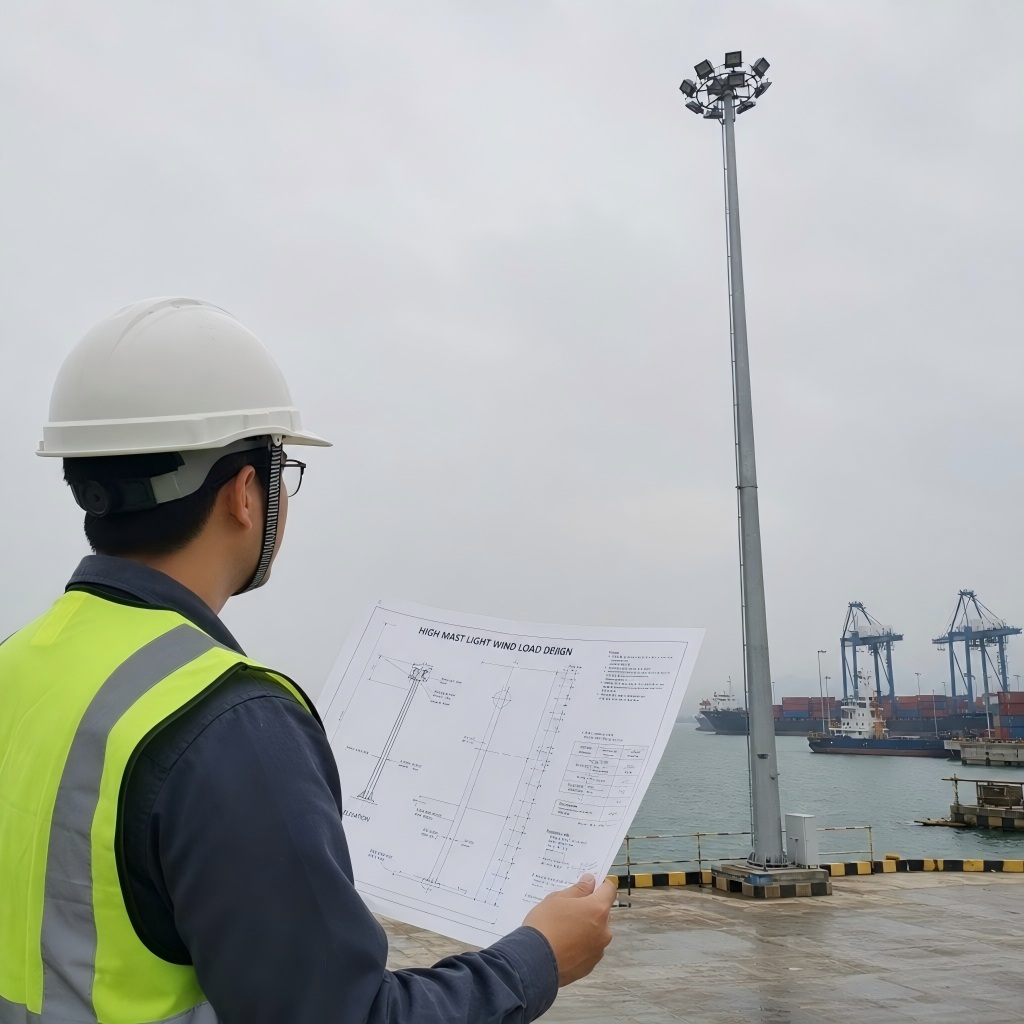
Coastal areas challenge high mast lights because they combine high wind exposure with a corrosive environment and difficult maintenance conditions. A typhoon does not only apply horizontal wind force. It may also bring vibration, wind direction changes, heavy rain, flying debris, power interruptions, and access limitations after the storm.
Open terrain is another major factor. A high mast installed beside the sea, on a port apron, or in a wide logistics yard may experience stronger wind than the same mast installed in a sheltered urban area. With fewer surrounding structures to reduce wind speed, the mast receives more direct pressure.
Coastal maintenance is also more demanding. Salt buildup, moisture, and heat can accelerate wear on electrical enclosures, lifting cables, winches, fasteners, and door seals. If maintenance is difficult, small issues can remain unnoticed until they affect safety. For this reason, structural safety should include inspection convenience, not only initial strength.
A safer coastal high mast design usually combines structural strength, corrosion control, installation accuracy, and maintenance planning. The following measures help reduce risk and support long-term performance:
Use site-specific wind load calculations. Avoid generic assumptions. The design should reflect local typhoon risk, mast height, terrain exposure, and the complete fixture arrangement.
Control the projected wind area. Select efficient luminaire layouts and avoid unnecessary accessories that increase drag without improving lighting performance.
Specify appropriate steel and fabrication quality. Material certificates, welding standards, dimensional accuracy, and factory quality control all matter.
Protect against corrosion from the beginning. Choose coatings, galvanizing, fasteners, and sealing details suitable for marine or coastal environments.
Match the foundation to the structure. The pole, base plate, anchor bolts, concrete block, and soil conditions should be designed as one system.
Plan for safe lowering and maintenance. Raising and lowering systems should be inspected regularly, especially cables, brakes, winches, guide devices, and locking mechanisms.
Check after severe storms. Even if the mast remains standing, inspection can identify loosened nuts, coating damage, door deformation, fixture movement, or hidden fatigue concerns.
These actions are practical, not excessive. In coastal projects, prevention is usually more economical than emergency repair, traffic interruption, or lighting failure after a typhoon.
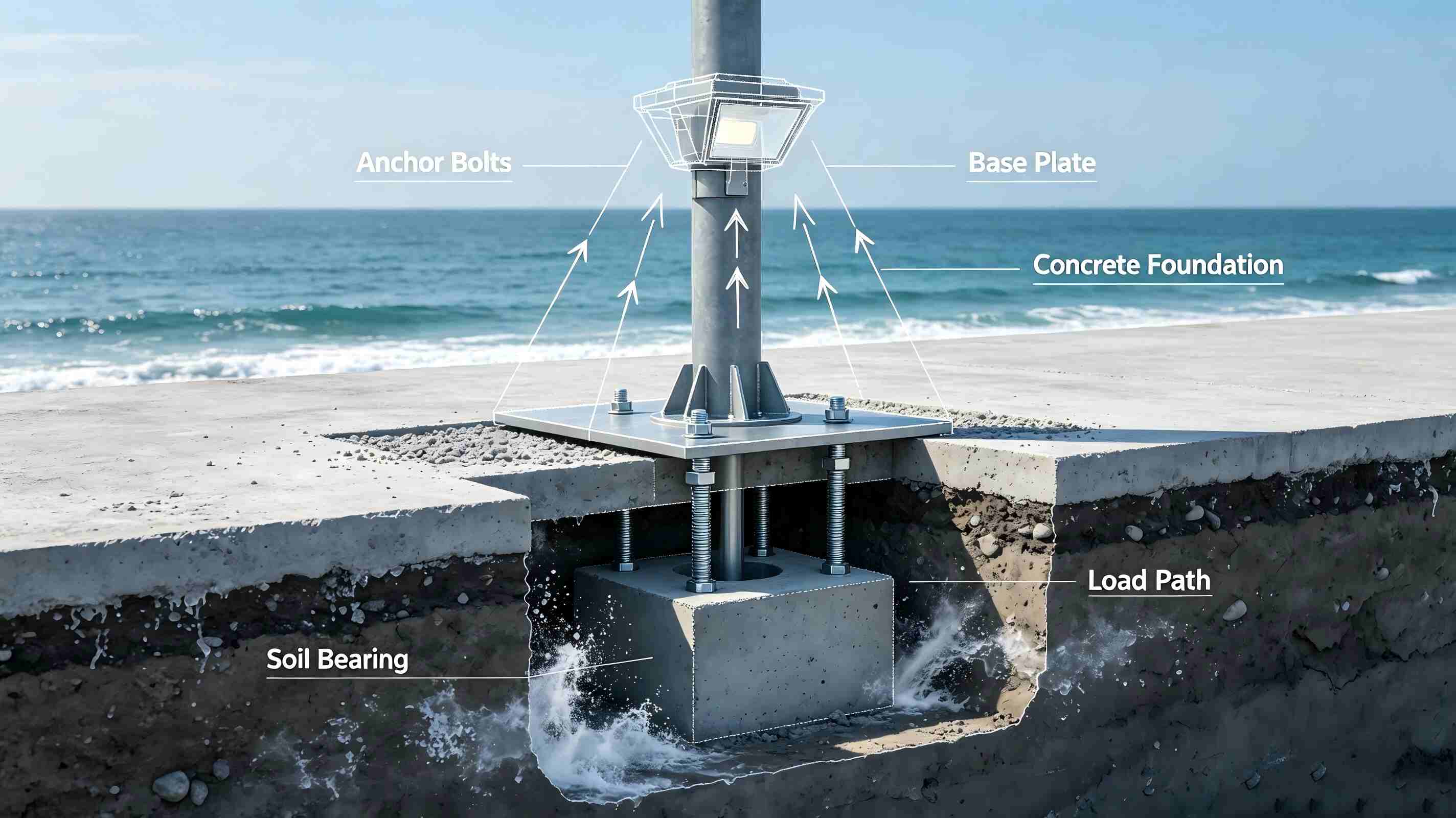
A high mast light is more than a steel pole. It is a structural, electrical, mechanical, and maintenance system working together. When one part is weak, the overall safety margin can be reduced.
For example, a pole may be designed for strong wind, but if installation crews do not tighten anchor nuts correctly, the base connection may not perform as intended. A lamp head may be structurally acceptable, but if extra fixtures are added without recalculation, the projected area may exceed the original design. A foundation may be strong, but if drainage is poor and corrosion progresses, long-term reliability can decline.
This is why project teams should require clear documentation before procurement and after installation. Useful documents may include structural calculation summaries, pole drawings, foundation drawings, material specifications, welding and coating information, installation instructions, and maintenance guidance. The more exposed the site, the more important this documentation becomes.
Before approving a high mast light for a coastal or typhoon-prone project, review the following points with the supplier, designer, and installer:
Confirm the required design wind speed and applicable local standard.
Check the mast height, pole sections, steel thickness, and material grade.
Review the number, size, weight, and arrangement of luminaires.
Verify whether future fixture additions are allowed or require recalculation.
Ask for foundation drawings suited to actual soil and site conditions.
Confirm anchor bolt specifications, base plate details, and installation tolerances.
Review corrosion protection for the pole, bolts, welds, access doors, and internal mechanisms.
Make sure the raising and lowering system is suitable for regular inspection and safe operation.
Establish an inspection plan after installation and after major storms.
Keep all design, installation, and maintenance documents accessible for future service teams.
This checklist helps turn the broad idea of “typhoon resistance” into verifiable project requirements. It also makes communication easier between owners, engineers, contractors, and manufacturers.
One common mistake is choosing a high mast light mainly by price while treating wind resistance as a simple product label. In reality, two masts with similar height can perform very differently depending on pole structure, fixture arrangement, steel quality, and foundation design. A low initial price may become costly if it leads to redesign, repair, downtime, or safety concerns.
Another mistake is copying a design from another locati0n. Even within the same region, exposure conditions can vary between a sheltered inland road and an open coastal terminal. Soil conditions, installation quality, and maintenance access may also be different.
A third mistake is ignoring changes after installation. Adding cameras, banners, antennas, extra luminaires, or other accessories can increase wind load. Any modification to a high mast should be reviewed before installation, especially in typhoon-prone coastal areas.
So, how many typhoon levels can a high mast light withstand? The safest answer is: the level confirmed by its engineered design wind speed, complete structural calculation, qualified manufacturing, correct foundation, and proper installation. A well-planned high mast design does not depend on vague claims; it proves wind resistance through clear requirements and a complete safety approach.
For coastal areas, this mindset is essential. Strong winds, salt corrosion, open exposure, and maintenance challenges all place extra pressure on lighting infrastructure. By focusing on site-specific engineering, corrosion protection, foundation reliability, and regular inspection, project teams can build high mast lighting systems that are safer, more durable, and better prepared for typhoon conditions.
Q1. How many typhoon levels can a high mast light withstand?
There is no universal answer. Typhoon resistance depends on the site-specific design wind speed, pole height and steel thickness, luminaire wind area, foundation strength, and local engineering standards. The safe answer is the level confirmed by a complete structural calculation, not a product label.
Q2. What are the key factors that affect high mast wind resistance?
The main factors are pole height and section design, total projected wind area of luminaires and brackets, steel material quality, base plate and anchor bolt strength, and foundation suitability for local soil conditions.
Q3. Why are coastal areas more demanding for high mast lights?
Coastal sites often have open terrain with higher wind speeds, salt spray causing corrosion, and difficult maintenance access. Typhoons also bring vibration, flying debris, and heavy rain, so the entire structure needs stronger corrosion protection and more frequent inspection.
Q4. How can project teams ensure typhoon safety for high mast lighting?
Use site-specific wind load calculations, control the wind area of the lighting assembly, specify appropriate steel and anti-corrosion treatment, match the foundation to the structure, and plan regular inspections—especially after severe storms. Avoid adding cameras or extra fixtures later without rechecking the wind load.
HRLUXSOLAR focuses on mid-to-high-end outdoor lighting with strict quality standards and a rigorous, responsible team. We take quality as the core and professionalism as the foundation to provide stable and durable outdoor lighting products.We specialize in professional services for municipal and commercial engineering projects, delivering customized lighting solutions for smooth project implementation. We support flexible customization, efficient delivery and full-process technical support to meet diverse project demands.Committed to being your trusted outdoor lighting partner, HRLUXSOLAR keeps improving to create better lighting value for your projects.
Get a Quote
Scan to Wechat/Whatsapp :