
HRLUX Lighting | Light the Globe, Power the Future


HRLUX Lighting | Light the Globe, Power the Future
LED luminaires rarely fail the way old lamps did: one day bright, the next day burned out. Instead, their light output gradually declines over time, which is why understanding lumen depreciation is essential when choosing, installing, or maintaining LED fixtures. If you have ever wondered, What Is "Lumen Depreciation" in LED Luminaires? How Do You Determine Fixture Lifespan?, the practical answer comes down to measuring how much useful light remains and knowing the conditions that speed up decline.
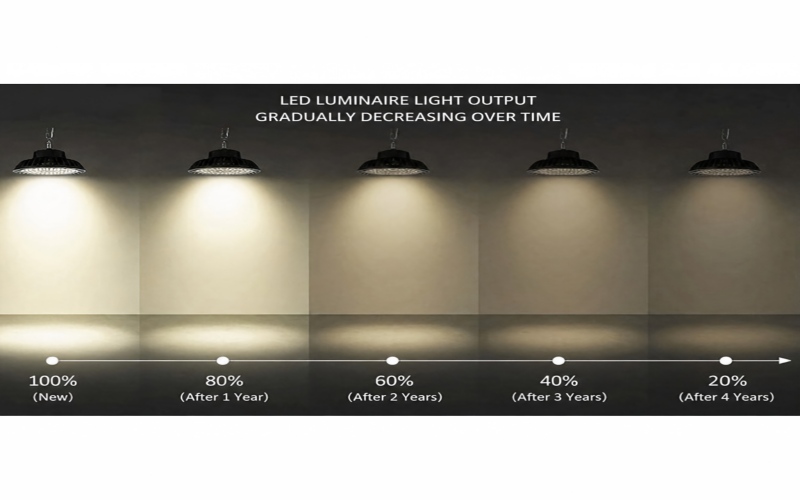
Lumen depreciation is the gradual reduction in visible light output from an LED luminaire as it operates over time. The fixture may still turn on and look normal, but it can deliver fewer lumens than it did when new. This matters because spaces, signs, parking areas, warehouses, and work zones are designed around a required light level, not simply around whether a fixture is still powered.
In traditional lighting, people often referred to lamp lumen depreciation, because the lamp was the replaceable light source. With LED lighting, the LEDs, optics, driver, housing, and thermal design all work together as a system. That means lumen maintenance is usually evaluated for the luminaire or LED package rather than a simple screw-in lamp.
A helpful way to think about it is this: lumen depreciation tells you how brightness declines, while lumen maintenance tells you how much brightness remains. If an LED fixture is at 70 percent lumen maintenance, it is producing about 70 percent of its original light output.
LED lifespan is often expressed using an “L” rating, such as L70, L80, or L90. These ratings describe the point at which the fixture is expected to maintain a certain percentage of its original light output. For example, L70 means the LED is projected to produce 70 percent of its initial lumens at a stated number of operating hours.
That does not mean the fixture suddenly dies at that hour mark. It means the light has depreciated to a threshold that may no longer meet the intended lighting design. For some applications, 70 percent may still be acceptable. For others, especially task lighting, security lighting, or illuminated signage, the fixture may need replacement or redesign before it reaches that level.
Here is the practical difference:
L90: Higher maintained output, often important where consistent brightness is critical.
L80: A balanced benchmark for many commercial and industrial applications.
L70: A common end-of-useful-life reference for general LED lifespan discussions.
Initial lumens: The light output when the fixture is new.
Maintained lumens: The light output after hours of operation and real-world exposure.
When comparing fixtures, do not look only at the highest initial lumen number. A fixture with stronger lumen maintenance may provide better usable light over time than a cheaper fixture that starts bright but fades quickly.
You determine fixture lifespan by looking at projected lumen maintenance, operating conditions, fixture quality, and the light level required for the application. The most useful lifespan estimate is not simply “how long it turns on,” but how long it continues to deliver enough light for the job. In other words, the right question is not only how many hours the LED can run, but how long the fixture remains useful.
Manufacturers commonly publish rated life based on testing and projections. These figures are helpful, but they depend on assumptions about temperature, drive current, installation, and environment. If a fixture is installed in a hot, enclosed, dusty, or poorly ventilated locati0n, its real performance may fall short of the ideal rating.
To evaluate fixture lifespan more realistically, consider these steps:
Start with the application requirement. Decide how much light the space, sign, or surface needs to remain effective.
Check the lumen maintenance rating. Look for L70, L80, or L90 data and the number of hours tied to that rating.
Review the operating environment. Heat, moisture, vibration, dirt, and enclosure design can all affect performance.
Consider operating hours. A fixture running 12 hours per day reaches lifetime milestones much sooner than one used occasionally.
Account for drivers and components. LED chips may last a long time, but drivers, seals, lenses, and wiring also influence service life.
Plan maintenance before failure. Cleaning lenses, checking ventilation, and replacing aging fixtures at the right time can prevent poor lighting quality.
This approach helps avoid the common mistake of treating a rated hour number as a guarantee. It is better to use rated life as a planning tool, then adjust expectations based on where and how the fixture is used.
Heat has a direct impact on LED performance. LEDs are efficient, but they still generate heat at the semiconductor junction and in related components. If that heat is not moved away properly, lumen depreciation can accelerate, color quality may shift, and electronic components may age faster.
This is especially important in signs, canopies, wall packs, parking lot fixtures, and enclosed luminaires. A fixture exposed to summer heat, direct sun, restricted airflow, or dark heat-absorbing surfaces may operate at higher internal temperatures than expected. For example, a business researching how heat affects LED sign lumen depreciation Wichita should think about long summer days, sun exposure, cabinet ventilation, and whether the sign face traps heat around the modules.
Thermal management is one reason two LED fixtures with similar wattage and initial lumens can perform very differently over time. Better heat sinks, thoughtful housing design, proper spacing, and quality drivers help keep temperatures under control. Poor thermal design may still look fine at installation, but the loss in brightness can become noticeable later.
Practical ways to reduce heat-related depreciation include:
Choose fixtures designed for the actual ambient temperature of the locati0n.
Avoid installing LEDs in sealed spaces unless the product is rated for that use.
Keep vents, lenses, and housings clean so heat can escape.
Do not exceed recommended drive currents or power supply specifications.
Use reputable fixtures with documented thermal performance rather than relying only on low upfront cost.
Lumen efficiency usually refers to how much light a fixture produces for the energy it consumes, often discussed as lumens per watt. It is an important performance metric because it affects energy use and operating cost. However, high lumen efficiency does not automatically prove a long LED lifespan.
A fixture can be efficient when new but still depreciate quickly if it is overdriven, poorly cooled, or built with lower-quality components. Likewise, a fixture with slightly lower initial efficiency may provide better long-term value if it maintains light output more consistently. The best evaluation looks at efficiency and lumen maintenance together.
When reviewing product information, pay attention to both starting performance and projected performance. Initial lumens tell you what the fixture delivers on day one. Maintained lumens tell you what you can expect after thousands of operating hours. For commercial spaces, that second number often matters more than the first because it affects visibility, safety, appearance, and maintenance planning.
Laboratory projections are useful, but fixtures live in real environments. Dust builds up on lenses. Drivers experience voltage variation. Outdoor fixtures deal with rain, heat, cold, insects, and UV exposure. Interior fixtures may be installed near heat-producing equipment or inside ceiling cavities with limited airflow.
Usage patterns also matter. Frequent switching is usually less damaging to LEDs than it was to older lighting technologies, but operating hours still accumulate. A 24-hour facility, illuminated sign, or security fixture will reach lumen maintenance thresholds far faster than lighting used only a few hours a week.
Before selecting or replacing LED luminaires, ask practical questions such as:
How many hours per day will the fixture operate?
Is the fixture indoors, outdoors, enclosed, or exposed?
Will dirt, moisture, chemicals, or vibration be present?
Is consistent brightness important for safety, branding, or productivity?
Can the fixture be cleaned, serviced, or replaced easily?
Does the manufacturer provide clear lumen maintenance information?
These questions turn LED lifespan from a vague marketing claim into a useful maintenance and budgeting decision.
The best lighting plans account for depreciation from the beginning. Designers may include a light loss factor so the system still performs adequately as fixtures age. This prevents a space from being underlit long before the luminaires stop working.
For businesses, the same idea applies to signs and exterior lighting. If a sign is bright on installation day but fades unevenly, the brand presentation suffers. If parking lot lights lose too much output, the property can feel less inviting or secure. Lumen depreciation is not just a technical detail; it affects how people experience a place.
A simple maintenance plan can make a noticeable difference:
Record installation dates and expected operating hours.
Inspect lighting levels visually at regular intervals.
Clean lenses, covers, and sign faces when dirt reduces light transmission.
Watch for uneven brightness, color shift, flicker, or dark sections.
Replace fixtures based on useful light output, not only total failure.
Lumen depreciation is the slow decline of LED light output, and lumen maintenance is the measure that tells you how much useful light remains. To determine fixture lifespan, look beyond the hour rating and evaluate heat, environment, operating schedule, component quality, and the minimum light level your application requires.
A good LED luminaire should not only be bright and energy efficient when new. It should maintain dependable light output for the way it will actually be used. When you understand that difference, it becomes much easier to compare products, plan maintenance, and choose lighting that keeps performing long after installation day.
Q1. What is lumen depreciation in LED luminaires?
Lumen depreciation is the gradual loss of light output over time. The fixture may still work, but it produces fewer lumens than when new, which can cause the space to fall below its required light level.
Q2. What do L70, L80, and L90 mean?
These ratings indicate how much of the original light output remains after a stated number of hours. L70 means 70% maintained output, L80 means 80%, and L90 means 90%. L90 is best for critical brightness needs, while L70 is a common end-of-useful-life reference.
Q3. How is LED fixture lifespan determined?
Lifespan is based on lumen maintenance, operating conditions, and the minimum light level required. Review the L-rating, daily operating hours, ambient temperature, and component quality rather than relying on a simple hour number.
Q4. What accelerates lumen depreciation?
Heat is the biggest factor. Poor thermal design, enclosed installations, high ambient temperatures, dirt buildup, and overdriving the LEDs can all speed up light loss and shorten useful life.
HRLUXSOLAR focuses on mid-to-high-end outdoor lighting with strict quality standards and a rigorous, responsible team. We take quality as the core and professionalism as the foundation to provide stable and durable outdoor lighting products.We specialize in professional services for municipal and commercial engineering projects, delivering customized lighting solutions for smooth project implementation. We support flexible customization, efficient delivery and full-process technical support to meet diverse project demands.Committed to being your trusted outdoor lighting partner, HRLUXSOLAR keeps improving to create better lighting value for your projects.
Get a Quote
Scan to Wechat/Whatsapp :