
HRLUX Lighting | Light the Globe, Power the Future


HRLUX Lighting | Light the Globe, Power the Future
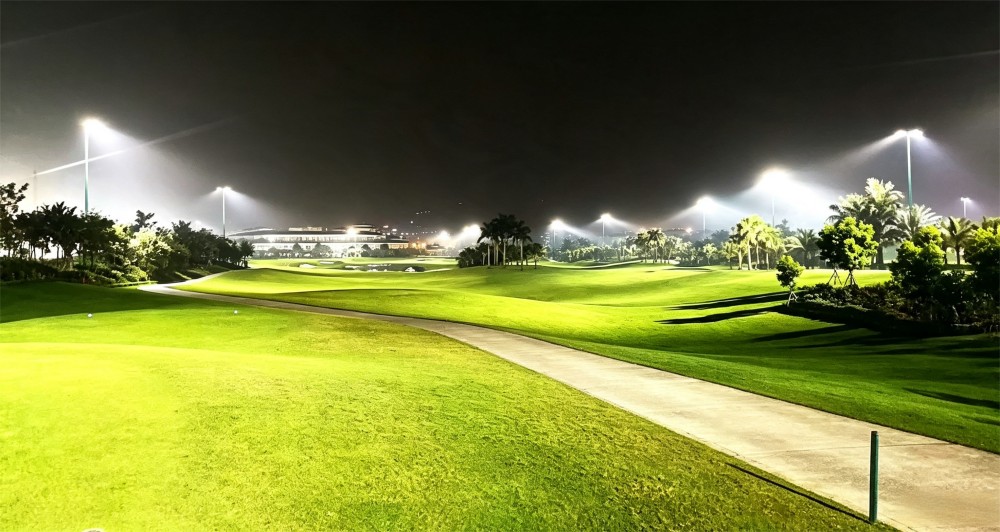
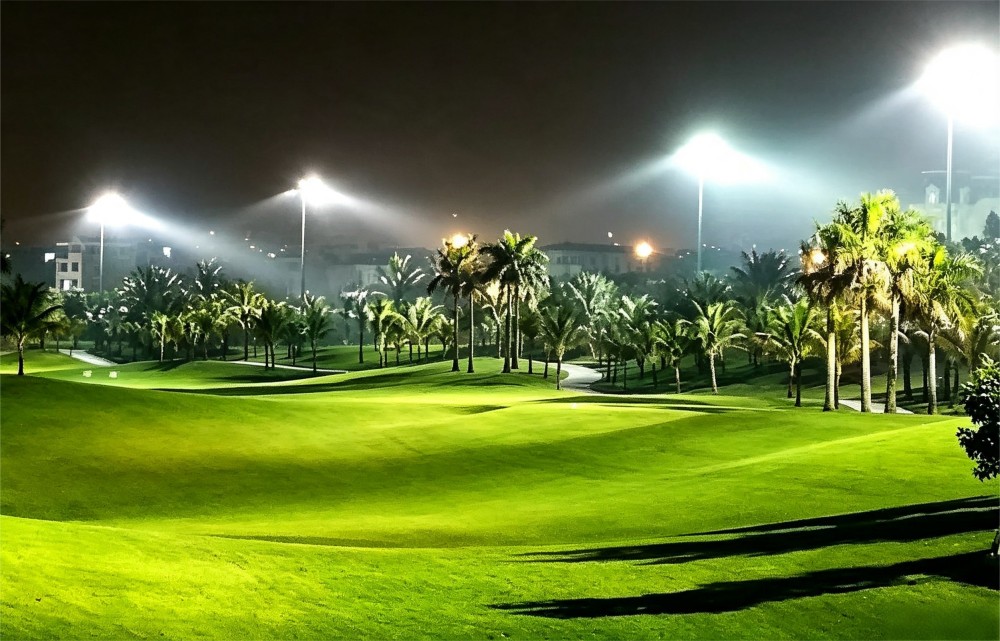
Golf course night lighting is a systematic customized project covering zoning standards, pole positioning, spacing calculation and special terrain adaptation. Scientific layout must be based on professional illuminance parameters and site actual conditions. HRLUX optimizes and sorts out a complete set of operable golf lighting layout methods and grading standards based on international specifications and global engineering experience, providing standardized, energy-saving and high-uniformity lighting design solutions for global golf venue renovation and new construction projects.
IESNA Class IV standard is applicable to recreational night golf and community amateur tournaments, focusing on uniform ground illumination, controllable glare and stable visual comfort. All data below refer to ground horizontal illuminance and professional uniformity coefficient (CV). CV (Coefficient of Variation) represents lighting uniformity; the smaller the value, the more uniform the field light distribution.
1.1 Basic Zone Illuminance & Uniformity Parameters
- Tee Box: 50 lx, CV ≤ 0.25 (Emax/Emin ≤ 3:1)
- Fairway: 30 lx, CV ≤ 0.35 (Emax/Emin ≤ 6:1)
- Long Grass & Auxiliary Fairway Zone: 50 lx, CV ≤ 0.35 (Emax/Emin ≤ 6:1)
1.2 Core Layout Precautions for Zone Lighting
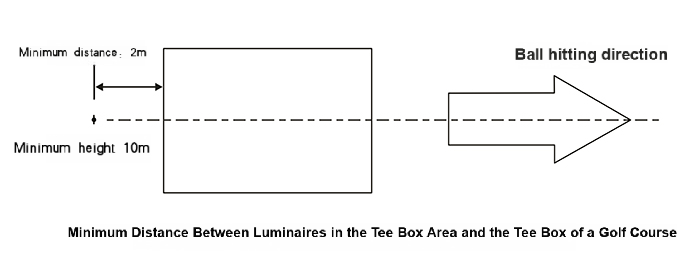
All HRLUX golf lighting layout schemes strictly avoid shadow occlusion caused by on-site trees, shrubs and terrain obstacles, ensuring full coverage of designated lighting areas without blind spots. For tee box lighting, light poles are recommended to be installed centrally behind the tee box with a reserved clearance of more than 2 meters, which effectively prevents players’ body shadows from covering the ball and affecting hitting judgment.
The mounting height of HRLUX golf light fixtures shall not be less than 10 meters, or half the effective length of the tee box (whichever is higher). For ultra-long customized tee boxes, multiple light poles can be deployed for supplementary lighting. All front light poles must not block the sightline and hitting path of the rear tee area.
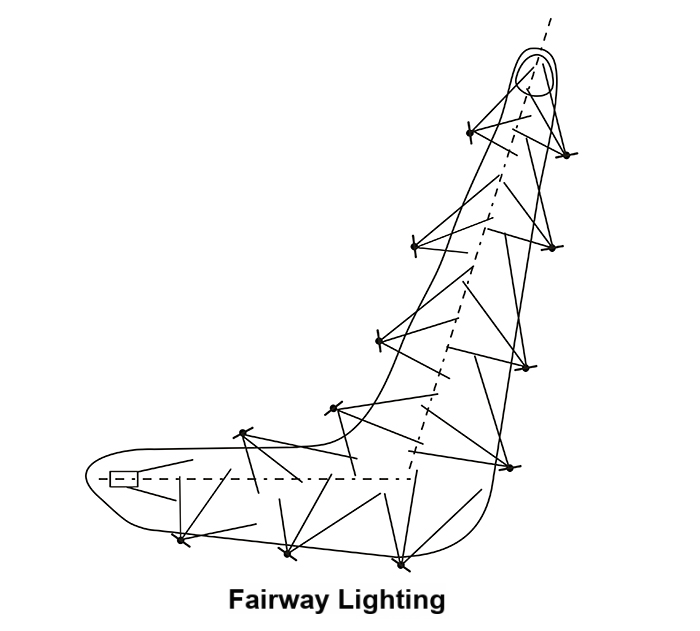
Fairway light poles are arranged on both sides of the fairway to form effective spill light coverage for the rough area, helping players quickly locate lost golf balls. HRLUX adopts targeted layout strategies according to fairway width:
1. Narrow fairway (width < twice the light pole height): staggered pole layout to reduce total equipment quantity and save investment;
2. Wide fairway (width > twice the light pole height): opposite symmetrical pole layout to improve overall uniformity.
To ensure optimal lighting uniformity, the spacing of HRLUX light poles is strictly controlled within 3 times the pole height. All fixtures adopt unified forward projection consistent with the golf hitting direction, equipped with professional anti-glare optical design to avoid light interference on adjacent fairways. For curved fairways, the beam angle is adaptively adjusted along the ball flight direction to eliminate dark zones.
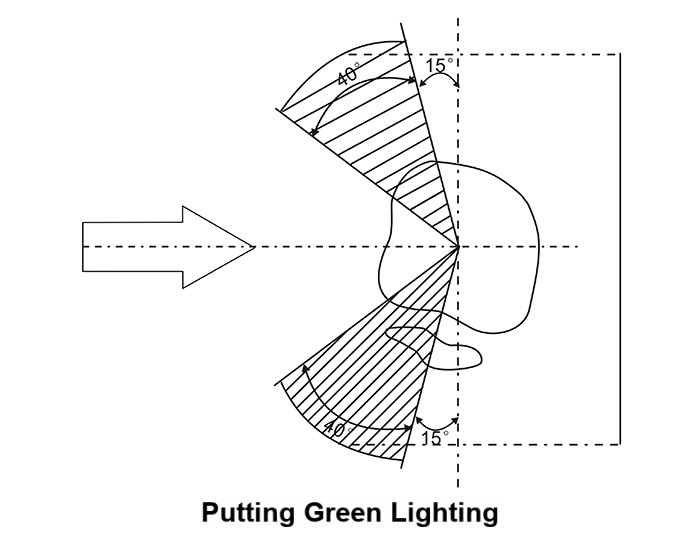
Putting green adopts bidirectional opposite lighting layout to avoid single-sided shadows covering the ball during putting. HRLUX arranges light poles in standardized shadow control areas to maximize glare suppression and prevent poles from obstructing hitting actions. Each pole is equipped with no less than 2 sets of professional golf fixtures. The overall design fully adapts to bunkers, water hazards, grass depressions and cart paths, with supplementary lighting poles configured for complex terrain to enhance ground-level illuminance and uniformity.
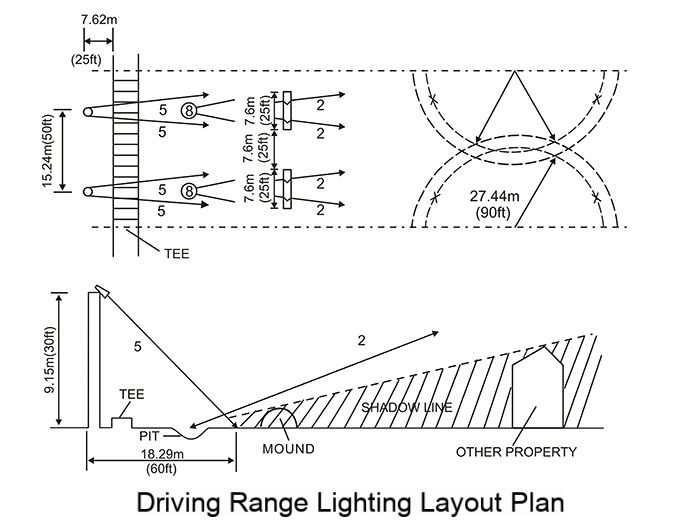
The golf driving range requires higher illuminance and uniformity than conventional fairways, needing clear tracking of ball flight trajectory and landing status. HRLUX follows IESNA professional standards for both horizontal and vertical illuminance design.
2.1 Horizontal & Vertical Illuminance Parameters
- Tee Box Horizontal Illuminance: 200 lx, CV ≤ 0.25 (Emax/Emin ≤ 3:1)
- Driving Range Vertical Illuminance: 100 lx, CV ≤ 0.25 (Emax/Emin ≤ 3:1)
Vertical illuminance test height: 1.83m–4.57m, covering the full landing zone width within 183 meters from the tee box.
2.2 Driving Range Layout Optimization & Precautions
Direct overhead lighting on the driving tee will cause severe glare and light spillage, which is forbidden in HRLUX design schemes. The optimized installation methods include rear tee mounting, tee roof mounting, perimeter net pole mounting, and hidden ground mounting behind landing zone bunkers.
Standard HRLUX driving range light poles adopt 15m fixed height with uniform spacing arrangement, with a minimum of 2 poles for a single tee area. The hidden installation behind sand bunkers realizes upward track lighting, effectively reducing sky glow and light spillage to adjacent areas, achieving zero-disturbance professional night lighting while meeting trajectory tracking needs.
Combined with international mainstream golf venue construction specifications and overseas project feedback, HRLUX divides golf course lighting into Class I (High-end Competition Level) and Class II (Standard Recreational Level), covering professional tournaments, business reception and daily leisure scenarios. All test heights and uniformity indicators comply with international certification standards.
Golf Course Two-Level Lighting Standard Table (HRLUX Optimized)
| Grade | Court Area | Minimum Illuminance (lx) | Uniformity Emin/Emax | Uniformity Emin/Eave |
| Class I | Main Service Table | Eh ≥ 200 lx | ≥ 0.5 | ≥ 0.7 |
| Second Service Table | No less than green average illuminance | ≥ 0.5 | ≥ 0.7 | |
| Fairway Horizontal | Eh ≥ 100 lx | — | ≥ 0.5 | |
| Fairway Vertical 球 | Ev ≥ 35 lx (green centerline) | — | — | |
| Putting Green | Eh ≥ 250 lx | ≥ 0.6 | ≥ 0.7 | |
| Class II | Main Service Table | Eh ≥ 180 lx | ≥ 0.5 | ≥ 0.7 |
| Second Service Table | No less than green average illuminance | ≥ 0.5 | ≥ 0.7 | |
| Fairway Horizontal | Eh ≥ 75 lx | — | ≥ 0.35 | |
| Fairway Vertical | Ev ≥ 20 lx (green centerline) | — | — | |
| Putting Green | Eh ≥ 220 lx | ≥ 0.6 | ≥ 0.7 |
Note: 1. Horizontal illuminance of service area and green is measured at 1m height above ground; 2. Vertical illuminance of fairway is measured at 25m height above the green surface; 3. HRLUX optimizes CRI≥85 and flicker-free design for all venue fixtures to meet professional sports visual needs.
4.1 Putting Green Light Pole Layout
The minimum height of green light poles is 12m, and the optimal height is 15m. Poles are installed at the rear or rear side of the green to avoid left/right-handed player shadow interference. For ultra-long greens, multiple poles are equipped for supplementary lighting. Edge poles are preferentially arranged on the right side of the green to fit mainstream hitting habits. All poles are placed outside the court to avoid blocking the hitting path.
Two Optional Design Modes
Economy Mode: The main tee area adopts the highest standard illuminance, and secondary areas adopt one-level lower standard. Poles are installed 5–7m behind the main tee, and other areas follow standard fairway layout principles.
Luxury High-Standard Mode: All tee areas and greens adopt the highest unified illuminance standard. Independent poles are configured for each green with 20–30m pole spacing and 5–7m distance from the green edge, realizing full-field uniform high-brightness lighting.
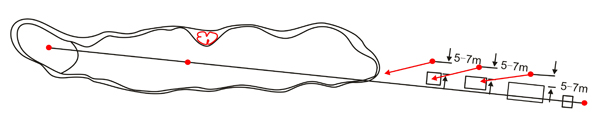
Economical putting green golf course lighting system: Fabric-mounted lighting configuration
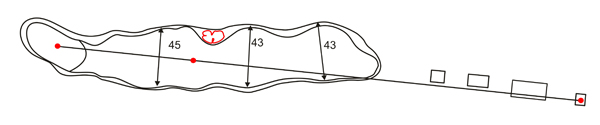
Luxury putting green golf course lighting system: ceiling-mounted lighting configuration
4.2 Fairway Light Pole Layout & Spacing Calculation
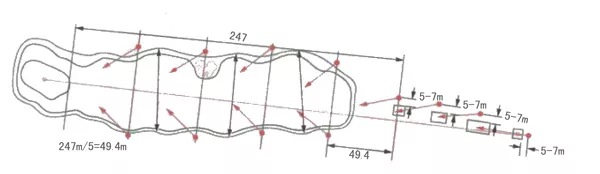
The minimum fairway light pole height is 15m. Poles are arranged 5–7m outside the fairway long grass area, avoiding bunkers and water hazards. The maximum pole spacing is 3 times the pole height, and the specific spacing is matched according to fairway width.
Fairway Width & Pole Spacing Matching Table
| Fairway Width (m) | Pole Height (m) | Adjacent Pole Spacing (m) |
| 40–45 | 15 | 50–55 |
| 45–50 | 15 | 45–50 |
| 50–55 | 15 | 40–45 |
| 55–60 | 15 | 40–45 |
Fairway pole quantity is calculated based on effective fairway length and standard spacing. HRLUX adopts dual calculation of economical spacing and optimal lighting spacing to balance project cost and lighting effect. For fairways adjacent to water bodies where staggered layout is unavailable, high-power anti-glare fixtures are used to balance bilateral brightness difference.
4.3 Ridge & Special Terrain Layout
Ridge light poles are 15m minimum and 18m optimal height, with a distance of more than 10m from the green edge to realize bidirectional uniform illumination. HRLUX fixtures support precise angle control, with 25°–30° projection angle and luminous intensity below 12000cd at 25° angle, effectively suppressing glare and avoiding direct light facing the green.
5.1 Dog-Leg Hole Layout
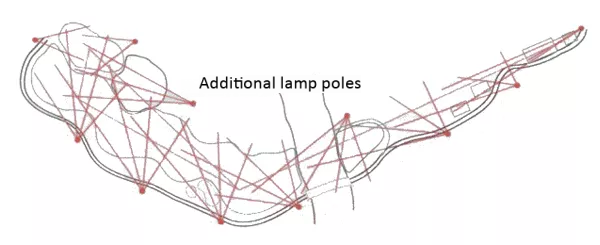
The pole layout of dog-leg holes follows standard fairway width and length calculation rules. Poles are arranged along the outer edge of the curve, and no poles are allowed to be installed inside the dog-leg bend to avoid interfering with ball hitting and rolling trajectory.
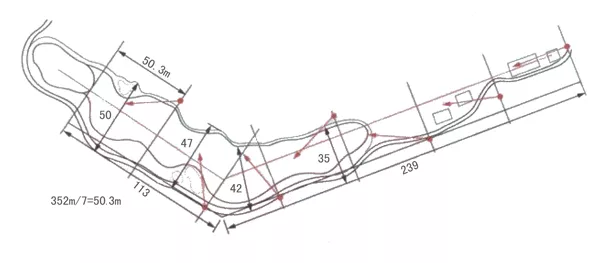
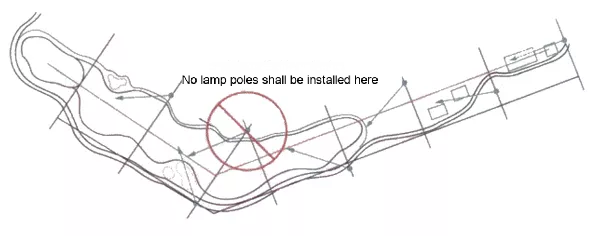
5.2 Back-to-Back Fairway Shared Poles
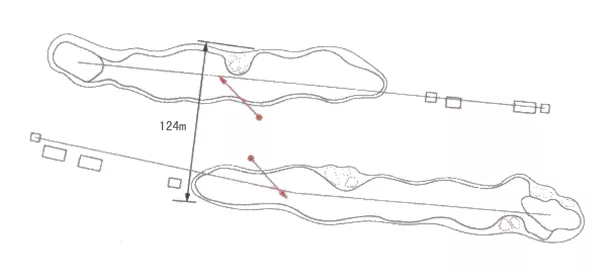
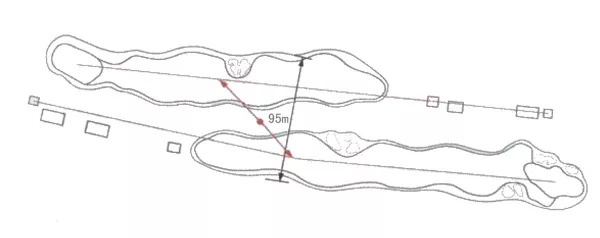
When the spacing between two parallel fairways ≤ 110m, HRLUX adopts a shared pole design to save construction cost; when the spacing > 110m, independent poles are configured separately to ensure sufficient illumination uniformity for both fairways.
5.3 Extra-Wide Fairway Layout
For fairways wider than 60m, HRLUX adopts double-sided synchronous lighting with 15m standard poles, appropriately increasing pole quantity to eliminate central dark zones and realize full-width uniform illumination.
5.4 Water Hazard Lighting Processing
Central water hazards of fairways adopt the same illumination standard as conventional fairways, ensuring consistent vertical illuminance for ball flight tracking. Water hazards in front of the green require enhanced vertical lighting to help players clearly observe the ball crossing the water barrier and landing trajectory.
Different from ordinary generic lighting schemes, HRLUX golf course lighting solutions fully comply with IESNA international standards, realizing precise zoning illuminance matching, zero-blind-spot layout, low-glare optical control and terrain adaptive customization. All fixtures adopt professional sports-grade optical lenses, with uniform light distribution, strong color restoration and flicker-free performance, which can effectively improve night sports experience and meet the acceptance standards of global amateur and commercial golf venues.
Q1: What are the national and international tournament illuminance standards for different areas of an 18-hole standard golf course?
A 1: Two sets of standards for recreational venues and professional tournament venues:
1.Recreational night golf course: Tee box 100lux, Fairway 70lux, Putting green 150lux, Hazard zone 50lux;
2.Professional tournament course: Tee box 200lux, Fairway 120lux, Putting green 300lux, Hazard zone 80lux;
Mandatory unified indicators: Illumination uniformity U0≥0.4, CRI≥70, complying with USGA and CIE international lighting specifications.
Q2: What layout differences exist for lighting of golf fairways, putting greens, tee boxes and hazard zones?
A 2:1.Tee box: Symmetric side-mounted lights at four corners with low-angle projection to avoid direct glare to golfers’ eyes;
2.Putting green: Surrounding cross lighting with multi-angle overlapping beams to eliminate putting shadows and realize uniform full-area illumination;
3.Fairway: Equidistant poles installed on both sides of the venue with narrow directional beam to cover the long strip fairway;
4.Sand bunkers & water hazards: Low-position single-side fill lights to reduce strong reflection on water and sand surfaces.
Q3: Can HRLUX dedicated LED golf floodlights equipped with Philips drivers meet anti-glare standards for night golf tournaments?
A 3: Absolutely compliant. Each light is fitted with honeycomb anti-glare grille and customized golf optical lens, with tested UGR value below 16. Original Philips constant-current driver ensures stable current control, all light beams project inside the venue without upward stray light, fully meeting USGA glare control standards for professional tournaments.
Q4: What is the minimum average illuminance required for a small 9-hole practice golf course to open night games to the public?
A 4: TMinimum standard for practice courses: tee box 80lux, fairway 50lux, green 120lux, uniformity ≥0.3, which meets the needs of amateur players for night practice.
Q5: How to calculate the installation height of light poles and pole spacing according to the area of the golf course?
A 5:Conventional scheme: pole height 12–18m; spacing 30–40m for recreational courses, 20–30m for tournament courses. HRLUX provides free Dialux optical simulation to generate accurate pole height, spacing and lamp quantity according to site size and terrain.
Q6: Can HRLUX dedicated LED golf floodlights equipped with Philips drivers meet anti-glare standards for night golf tournaments?
A 6: Ordinary lamps produce upward spill light and light pollution. HRLUX golf lights adopt cut-off optical design, upward light output less than 3%, narrow beam lens to confine all light inside the venue, complying with urban light pollution regulations.
HRLUXSOLAR focuses on mid-to-high-end outdoor lighting with strict quality standards and a rigorous, responsible team. We take quality as the core and professionalism as the foundation to provide stable and durable outdoor lighting products.We specialize in professional services for municipal and commercial engineering projects, delivering customized lighting solutions for smooth project implementation. We support flexible customization, efficient delivery and full-process technical support to meet diverse project demands.Committed to being your trusted outdoor lighting partner, HRLUXSOLAR keeps improving to create better lighting value for your projects.
Need a Dialux simulation for your project? Click here for a free lighting plan.
Get a Quote
Scan to Wechat/Whatsapp :